
Dynamic creative optimization (DCO) automatically assembles and serves the highest-performing ad combination per impression, selecting from a pool of headlines, images, videos, and CTAs to raise relevance and protect ROAS at scale. If your campaign has a measurable conversion event, an audience large enough to generate learning signal, and at least a basic product feed or data layer, DCO belongs in your media infrastructure now, not later.
Quick-check: should you prioritize DCO this quarter?
- Data readiness: You have a product feed, CRM segment, or event-level signal you can pipe into an ad platform.
- Creative pipeline: Your team can produce 3–4 meaningfully different variants per creative slot, not just resized copies of one hero image.
- Measurement: You have a conversion event firing reliably and attribution configured before launch, not after.
Key Takeaways
DCO delivers durable ROAS improvement only when asset diversity, feed integrity, and parallel measurement discipline are all in place from launch.
| Point | Details |
|---|---|
| Asset diversity is the ceiling | Load slots with variants that genuinely disagree in angle; near-clones produce arbitrary convergence, not real signal. |
| Exploration window is 24–72 hours | Monitor delivery anomalies in the first three days; do not optimize or pause combinations during this window. |
| DCO does not replace structured testing | Run controlled A/B tests in parallel to generate element-level causal insights DCO cannot provide on its own. |
| Privacy compliance is pre-launch work | Implement a CMP and server-side event collection before connecting any CRM or CDP feed to a live DCO campaign. |
| Monstrousmediagroup builds the system | MMG’s managed DCO engagements cover feed engineering, asset pipelines, BI integration, and ongoing creative refresh. |
Table of Contents
- How does dynamic creative optimization work end-to-end?
- When does DCO outperform static creative, and when does it not?
- Which platforms support DCO and what are they best at?
- How do you set up a DCO campaign from scratch?
- What should you measure and how do you iterate?
- What privacy and compliance rules apply to DCO in the US?
- What are the most common DCO failures and how do you fix them?
- How Monstrousmediagroup runs a DCO program: the 8-week agency workflow
- DCO is infrastructure, not a campaign feature
- Monstrousmediagroup builds DCO as a revenue system, not a campaign feature
- Sources
How does dynamic creative optimization work end-to-end?
DCO has four core components that must all be in place before the optimization engine can do anything useful.
1. The data feed or dataset. This is the input layer: a product catalog, a CRM audience segment, a real-time signal (weather, inventory, location), or a combination. Google Studio documents the required pieces as a feed or profile fields, an HTML creative shell, content rules, and integration steps. Without a clean, validated feed, the rest of the system has nothing to pull from.
2. The creative template (shell). A single HTML or platform-native template with defined slots: headline, subheadline, image, video, CTA, logo. The shell renders differently for each impression based on what the feed and rules supply to each slot.
3. Content rules and logic. Rules govern which asset goes into which slot under which conditions. A retailer might map product category to image slot, audience segment to headline, and inventory status to CTA. Rules prevent nonsensical combinations and keep brand guardrails intact.
4. The optimization engine. Platform ML takes over at serving time. It runs combinatorial delivery, meaning it tests combinations across the slot matrix, not individual elements in isolation. Industry analysis confirms these systems prune exploration within 24–48 hours and converge on a small number of winning combinations. Asset diversity, specifically meaningful disagreement between variants, drives the performance ceiling more than slot counts alone.
The runtime flow
Assets upload and map to slots. The platform generates a theoretical combination space from those slots. During the exploration window (roughly the first 24–72 hours), the engine samples broadly. It then prunes weak combinations and shifts spend toward the top performers. Google Responsive Search Ads support up to 15 headlines and 4 descriptions; TikTok’s Automated Creative Optimization (ACO) and Meta’s Advantage+ Creative each have their own slot caps and combinatorial logic. The practical result across all three: the engine typically converges on 2–3 dominant combinations regardless of how many you loaded.
Data sources feeding the pipeline include CDPs and CRMs (audience segments, lifecycle stage, purchase history), product feeds (SKU-level attributes, pricing, availability), and real-time signals (geolocation, device type, time of day, weather). Each source maps to specific slots in the template through the content rules layer.
Pro Tip: Name every creative asset with a consistent taxonomy before upload: [format][angle][slot]_[variant]. This makes element-level reporting readable and speeds up QA when a combination misfires.
When does DCO outperform static creative, and when does it not?
DCO’s core advantage is personalization at scale. A single creative shell can serve thousands of contextually relevant combinations without manual trafficking for each one. Google Studio’s documentation notes that a single dynamic creative reduces trafficking overhead while enabling per-impression relevance. For ecommerce, automotive, financial services, and CPG, where audience segments and product catalogs are large and conversion signals are measurable, that efficiency compounds quickly.
The limitations are real and often understated. DCO’s optimization engine selects winners per user and optimizes delivery, but it does not produce clean element-level causal learnings. If you need to know why a headline outperformed another, DCO alone will not tell you. You need a separate structured A/B test for that. DCO also requires audience volume to generate signal; thin audiences starve the model and produce unreliable convergence.
Decision checklist before committing to DCO:
- Conversion event fires reliably and is mapped to your attribution window.
- Audience pool is large enough to generate a learning signal within your flight window.
- Creative team can produce variants that genuinely disagree in angle, not just color or font.
- You have a plan for running separate structured tests when you need causal element-level data.
Pro Tip: Run DCO and structured A/B tests in parallel, not in sequence. Use DCO to optimize delivery and use controlled experiments to answer “why.” Collapsing both jobs into DCO alone is the single most common measurement mistake.
Which platforms support DCO and what are they best at?
Each major platform implements DCO differently. Matching your use case to the right platform’s architecture saves significant engineering time and budget.
Google Marketing Platform and Google Ads
Google Studio supports full dynamic creative with feed-driven slot mapping, content rules, and HTML shell rendering. Google Ads Responsive Search Ads handle text-based DCO natively with up to 15 headlines and 4 descriptions. Best for: search intent capture, display retargeting, and YouTube video personalization. Requires feed schema work and Studio familiarity for rich media; RSAs are low-engineering-effort.
Meta Advantage+ Creative
Meta’s implementation applies automated creative enhancements and dynamic combinations across image, video, text, and CTA slots. Advantage+ Creative pulls from your asset library and applies platform-level optimizations including background generation and music addition for Reels. Best for: broad audience prospecting, ecommerce catalog retargeting, and CPG. Feed integration via Commerce Manager is well-documented and relatively low-friction.
Amazon Ads
Amazon Ads provides practical DCO guidance with examples showing creative adaptation to audience signals, including product-level personalization tied to browsing and purchase history. Best for: retail and ecommerce advertisers with Amazon catalog integration. The closed-loop attribution (ad exposure to purchase on Amazon) is a significant measurement advantage for product-level ROAS.
Criteo
Criteo’s DCO is built around commerce media: product feed-driven retargeting with real-time inventory and pricing signals. Best for: ecommerce retargeting, particularly for advertisers with large SKU catalogs and high browse-to-purchase intent signals. Criteo’s strength is its shopper graph and the depth of its product feed integration.
TikTok For Business
TikTok’s Automated Creative Optimization assembles video and image combinations from uploaded assets and tests them against audience signals. Best for: CPG, entertainment, and direct-to-consumer brands with strong video creative libraries. The platform’s algorithm favors high-energy, native-feeling content; generic display assets underperform significantly compared to purpose-built TikTok formats.
The Trade Desk
The Trade Desk supports DCO through its open programmatic infrastructure, allowing advertisers to connect third-party creative management platforms and data sources for cross-channel dynamic delivery. Best for: enterprise advertisers running cross-channel programmatic campaigns who need a DSP-level view across display, video, audio, and CTV. Engineering effort is higher; the payoff is unified frequency management and cross-channel creative sequencing.
| Platform | Best for (vertical) | Data sources | Creative flexibility | Engineering effort | Measurement |
|---|---|---|---|---|---|
| Google Studio / RSA | Search, display, YouTube | Feed, CRM, real-time | High (HTML + video) | Moderate to high | GA4, Campaign Manager |
| Meta Advantage+ | Ecommerce, CPG, DTC | Catalog, pixel, CRM | Moderate (auto-enhance) | Low | Meta Ads Manager |
| Amazon Ads | Retail, ecommerce | Amazon purchase data | Moderate | Low to moderate | Amazon Attribution |
| Criteo | Ecommerce retargeting | Product feed, shopper graph | Moderate | Moderate | Criteo dashboard |
| TikTok ACO | CPG, DTC, entertainment | Pixel, catalog | Moderate (video-first) | Low | TikTok Ads Manager |
| The Trade Desk | Enterprise cross-channel | DSP data, CRM, DMP | High (open CMP) | High | Unified ID, BI export |
Pro Tip: Do not run the same creative shell across Google and TikTok without platform-specific adaptation. TikTok’s algorithm penalizes content that looks like a banner ad. Build platform-native variants from the start.
How do you set up a DCO campaign from scratch?
This is the agency playbook Monstrousmediagroup uses to take a DCO program from scoping to scaled rollout.
Step 1: Campaign scoping
Define the objective (awareness, consideration, or conversion), the primary conversion event, audience buckets (prospecting, retargeting, CRM-matched), and test constraints (budget floor, flight window, geographic scope). Document these before touching any platform.
Step 2: Asset pipeline
Break creatives into slots: headline, body copy, image, video, CTA, logo. Target 3–4 meaningfully different variants per slot. “Meaningfully different” means different angle, not different color. A price-led headline, a benefit-led headline, a social-proof headline, and a urgency-led headline disagree. Four versions of “Shop Now” do not.

Industry analysis recommends pulling long-running, spend-validated competitor variants as seed material, tagging by hook, angle, and format, and deliberately loading slots with disagreement so the platform resolves signal faster.
Step 3: Data work
Prepare your product feed (validate schema, check for missing fields, confirm pricing and inventory accuracy). Map CRM or CDP segments to audience buckets. Define content rules: which segment sees which headline variant, which product category maps to which image slot. Set rendering constraints to prevent nonsensical combinations.
For AI-assisted creative generation, AI content creation tips for marketers work best as a generator-critic to produce a high-recall slate for online adaptive testing. Use the model to compose the test slate, not to pick a single deployment candidate.
Step 4: Pre-launch QA
- Validate feed schema: check for null values, broken image URLs, and price formatting errors.
- Preview creative rendering across all slot combinations in the platform’s preview tool.
- Confirm pixel and conversion event firing with a tag audit tool (Google Tag Assistant, Meta Pixel Helper).
- Verify UTM parameters and tracking URLs on every combination.
- Run a measurement sanity check: confirm attribution window matches your reporting window.
Step 5: Launch and initial monitoring
Launch with a defined exploration budget. Monitor the first 24–72 hours for delivery anomalies: spend concentration on a single combination too early, zero delivery on specific slots, or CPA spikes that suggest a bad combination is winning. Do not optimize or pause during the exploration window unless you see a clear error.
AppsFlyer’s creative optimization guide documents how creative intelligence platforms can aggregate element-level performance data across campaigns and feed BI exports, which is the right infrastructure for monitoring at this stage.
Pro Tip: Build your QA checklist into a shared doc before launch day. The pressure of a live campaign is the worst time to remember that you forgot to validate the feed’s image URL field.
What should you measure and how do you iterate?
Core KPIs
Track CPA and ROAS as primary signals for conversion campaigns. For upper-funnel DCO, shift to video completion rate, click-through rate, and view-through conversions. Spend share by combination tells you whether the model is converging or still exploring.
Attribution caveats
DCO affects element-level attribution because the platform reports at the ad-set or campaign level, not the combination level. You can see which ad set won, but isolating the contribution of a specific headline requires a separate structured test. Combine aggregated DCO ad-set KPIs over a 7-day window with separate structured A/B tests when you need causal element-level learning.
Research on offline-to-online creative optimization shows that using predictive models to guide generative creative candidate generation, followed by adaptive online experiments, produces substantially better outcomes than human-only workflows. The practical implication: use your DCO performance data to brief the next round of creative generation, not just to report on the last round.
Optimization cadence
- Weeks 1–2: Exploration window. Monitor delivery and CPA. Do not pause combinations.
- Weeks 3–4: Pruning window. Remove combinations with zero spend or CPA more than 2x your target. Seed one new angle variant per slot.
- Monthly: Refresh the asset pool. Retire combinations that have been dominant for more than 6 weeks (creative fatigue is measurable in declining CTR and rising frequency).
- Quarterly: Run a structured A/B test outside DCO to validate a hypothesis the DCO data surfaced.
Pro Tip: Set a calendar reminder for the 6-week mark on every DCO campaign. Platforms will keep spending on a fatigued winner long after it stops performing for real users.
What privacy and compliance rules apply to DCO in the US?
DCO’s personalization depends on data signals, and US privacy law is tightening around exactly those signals.
CCPA/CPRA: California’s Consumer Privacy Act and its 2023 amendments (CPRA) give California consumers the right to opt out of the sale or sharing of personal information, including data used for targeted advertising. If your DCO feed pulls from a CRM or CDP that contains California consumer data, you need a compliant opt-out mechanism and a data processing agreement with your ad platform.
COPPA: If any audience segment could include users under 13, COPPA prohibits behavioral targeting. Platform policies (Meta, Google, TikTok) layer additional restrictions on top of COPPA for users under 18.
Practical mitigations:
- Implement a consent management platform (CMP) before connecting any first-party data source to a live DCO feed.
- Shift to server-side event collection to reduce reliance on browser cookies, which are increasingly blocked or restricted.
- Use first-party data (email lists, CRM segments, loyalty program data) as your primary signal source. Third-party cookie deprecation makes this non-optional for durable DCO programs.
- Avoid creative variations that target sensitive attributes (health status, financial distress, political affiliation) in slot rules. Even where technically permitted, these variations carry regulatory and brand risk.
Privacy review checklist before connecting a CDP/CRM feed:
- Confirm data processing agreements are in place with every platform receiving the feed.
- Verify opt-out signals from your CMP propagate to the ad platform’s audience suppression list.
- Audit the feed schema for sensitive fields and remove or hash them before upload.
- Document the legal basis for processing each data category in the feed.
Pro Tip: Server-side event collection is the single highest-leverage privacy infrastructure investment for DCO programs. It reduces signal loss from browser restrictions and gives you a compliant, durable data layer that third-party cookie deprecation cannot touch. Monstrousmediagroup’s marketing automation infrastructure is built to support exactly this kind of server-side integration.
What are the most common DCO failures and how do you fix them?
Most DCO programs fail for operational reasons, not strategic ones. The failure modes are predictable and fixable.
Top failure modes:
- Poor asset diversity: Slots loaded with near-clones. The model converges on an arbitrary winner because there is no real signal to resolve.
- Bad tracking: Conversion event misfires or fires on the wrong page. The model optimizes toward a phantom signal.
- Small audience: Insufficient volume to generate learning signal. The model never exits exploration.
- Overloaded slots: Too many variants, most of them weak. The exploration window extends, wasting budget on low-quality combinations.
- DCO as the only test method: No structured A/B tests running in parallel. Teams lose the ability to generate causal insights and brief better creative.
Troubleshooting checklist
- Check spend distribution: if one combination holds more than 80% of spend within 48 hours, audit whether it is genuinely winning or whether weak competition is the explanation.
- Check conversion event volume: if CPA is spiking, verify the pixel is firing correctly before adjusting bids or pausing combinations.
- Check audience size: if delivery is slow or erratic, the audience may be too small to generate signal. Broaden or merge segments.
- Check creative diversity: pull a spend-share report by combination. If the top 2 combinations look nearly identical, your asset pool has a diversity problem.
Quick fixes:
- Creative refresh: retire the bottom 25% of combinations by spend efficiency and seed 2 new angle variants per slot.
- Re-tagging: audit and fix conversion event firing before touching any creative or bid settings.
- Controlled A/B test: if you cannot diagnose the problem from DCO data alone, pause DCO and run a structured test to isolate the variable.
How Monstrousmediagroup runs a DCO program: the 8-week agency workflow
This is the production workflow Monstrousmediagroup uses for client DCO engagements, from discovery to scaled rollout.
Role matrix
| Role | Responsibility |
|---|---|
| Strategy | Objective setting, audience architecture, test constraints, KPI definition |
| Creative Ops | Asset production, slot mapping, variant disagreement review, fatigue monitoring |
| Analytics | Feed validation, pixel QA, attribution configuration, reporting cadence |
| Engineering | Feed integration, server-side event collection, CDP/CRM mapping, tag management |
| Client PM | Stakeholder alignment, approval gates, timeline management |
8-week timeline
| Week | Milestone |
|---|---|
| - | Discovery: objective, audience buckets, data audit, platform selection |
| 1–2 | Asset pool build: creative brief, production, slot mapping, variant review |
| 2–3 | Feed integration: schema validation, CRM/CDP mapping, content rules, QA |
| 3–4 | Pre-launch QA: pixel audit, rendering previews, tracking validation, sanity checks |
| 4–5 | Initial launch: exploration window, 24–72 hour monitoring, delivery anomaly review |
| 5–6 | Pruning window: remove underperformers, seed new angle variants, CPA review |
| 6–7 | Scaled rollout: increase budget on validated combinations, expand to secondary platforms |
| 7–8 | Reporting and brief: element-level insights, structured A/B test design, next creative brief |
Pro Tip: The brief that comes out of week 7–8 is the most valuable output of the entire engagement. DCO data tells you which angles the platform rewarded. That signal should directly inform the next creative sprint, not sit in a dashboard no one reads.
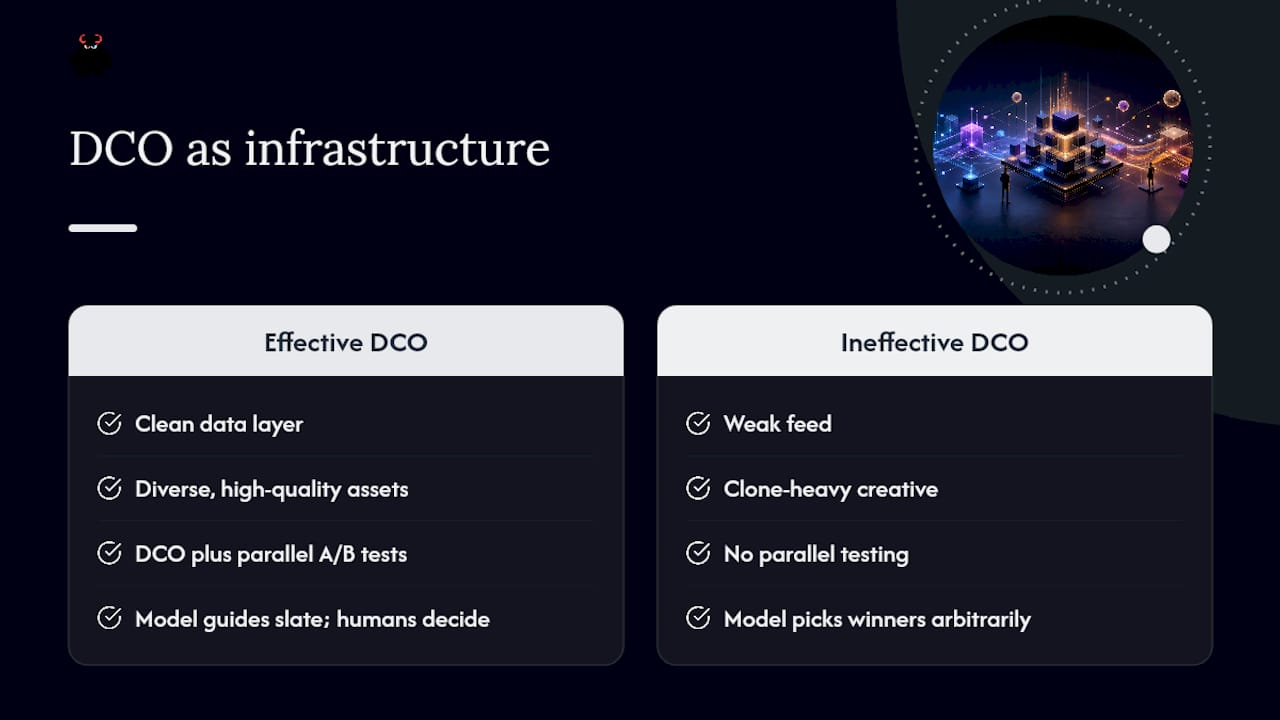
DCO is infrastructure, not a campaign feature
The conventional advice on dynamic creative optimization focuses on setup steps and platform features. That framing misses the point. DCO is a production system. It requires the same operational discipline as any revenue-critical infrastructure: validated inputs, monitored outputs, defined escalation paths, and a regular refresh cadence.
Most advertisers underinvest in the asset pool and overinvest in platform configuration. The platform’s optimization engine is not the constraint. The constraint is almost always creative quality and diversity. A model given four near-identical headlines will converge on one of them arbitrarily and call it a winner. A model given four headlines that genuinely disagree in angle, proof point, and emotional register will surface a real signal.
The second thing most teams get wrong is treating DCO as a replacement for structured testing. It is not. DCO selects winners per user. It does not explain why a winner won. Teams that abandon controlled experiments because “DCO handles testing” lose the ability to generate creative hypotheses and brief better work. The right model is DCO for delivery optimization and structured A/B tests for causal learning, running in parallel, feeding each other.
For AI-driven creative generation, an offline-to-online approach using predictive models to generate a candidate slate, followed by adaptive online experiments, consistently outperforms human-only creative workflows. The model should guide slate composition, not make final deployment decisions. That distinction matters operationally: it keeps human creative judgment in the loop while compressing the time from brief to validated winner.
DCO built on a clean data layer, a diverse asset pool, and a disciplined measurement cadence is one of the highest-leverage revenue protection systems available to a performance advertiser. Built on a weak feed, clone-heavy creative, and no parallel testing, it is an expensive way to learn nothing.
Monstrousmediagroup builds DCO as a revenue system, not a campaign feature

Monstrousmediagroup’s AI-powered digital marketing services treat DCO as production infrastructure, not a platform checkbox. The engagement covers DCO program audits, asset pipeline construction, feed engineering, measurement and BI integration, and managed DCO operations across Google, Meta, Amazon, TikTok, and programmatic DSPs.
Every DCO engagement is built on a clean server-side data layer, a validated feed schema, and a creative brief process that produces genuine variant disagreement from day one. Measurement is configured before launch, not retrofitted after. Private AI and BI integrations connect DCO performance data directly to your reporting stack, so the signal from each campaign informs the next creative sprint rather than disappearing into a platform dashboard.
If your current DCO program is converging on weak combinations, running on a thin asset pool, or producing no usable creative intelligence, that is a system problem, and it has a system solution. Schedule a DCO audit with Monstrousmediagroup’s advertising services team to identify where the revenue leak is and what it takes to fix it.
Sources
The following sources back the technical claims in this guide and are worth bookmarking for your own DCO program documentation.
- About dynamic creatives - Studio Help
- Dynamic Creative in 2026: How DCO Picks the Winner
- Creative Optimization guide - AppsFlyer
- 2607.23696 Offline-to-Online Creative Optimization with Generative Models and Adaptive Testing