
The highest-impact AI SEO strategies currently focus on crawlability fixes, answer-first content blocks, original data publication, and a tracked AI-visibility workflow. Teams that implement these consistently report measurable citation gains across Google AI Overviews, Perplexity, and ChatGPT, leading to recoverable traffic and qualified leads.
Start here - assign these today:
- Open AI crawler user agents in robots.txt (GPTBot, Google-Extended, ClaudeBot)
- Add 120–150-word answer capsules directly under each H2 on priority pages
- Publish at least one original statistic or proprietary data point per pillar page
- Run a monthly prompt test suite across ChatGPT, Perplexity, Gemini, and Google AI Overviews
- Tag AI referral traffic as a separate channel group in GA4
- Audit schema coverage: Article, FAQPage, HowTo, and Author entity markup
Practitioners who track AI citation rates separately from traditional rank report that citation wins compound. A page that earns a Perplexity citation often gains Google AI Overview mentions within the same measurement cycle, and AI-referred visitors tend to arrive with higher purchase intent than cold organic traffic. The revenue case for getting this right is not theoretical.
Key Takeaways
The highest-impact AI SEO strategies combine technical access, answer-first content structure, original data, and a tracked measurement workflow - teams that execute all four consistently recover citations and leads that competitors are currently capturing.
| Point | Details |
|---|---|
| Crawlability is the prerequisite | Allow AI crawler user agents in robots.txt and serve content in raw HTML or SSR before any other optimization. |
| Answer capsules drive citation probability | Place self-contained answer blocks of appropriate length directly under H2 headings on every priority page to enable AI extraction. |
| Original data is the citation hook | Publish at least one proprietary statistic or original finding per pillar page; generic summaries do not earn citations. |
| Measure mention rate, not just rank | Track citation rate, mention position, and AI-referral conversions in GA4 as a separate channel group. |
| Monstrousmediagroup delivers the full system | MMG’s SEO infrastructure covers audit, technical fixes, content programs, and monthly prompt-test reporting for measurable lead recovery. |
Table of Contents
- What are the most effective AI SEO strategies right now?
- How should you use AI in content creation without producing commodity output?
- Which technical SEO fixes most directly affect generative-AI extraction?
- How do you measure AI-driven SEO outcomes and run repeatable experiments?
- How should you select tools and design AI+human workflows?
- What does a realistic 90-day AI SEO rollout look like?
- How Monstrousmediagroup builds AI SEO systems that protect revenue
- What a single-SEO team should prioritize this quarter
- Monstrousmediagroup builds the AI visibility infrastructure your team needs
- Sources
What are the most effective AI SEO strategies right now?
The most effective AI-driven SEO tactics follow a four-stage production model: Crawlable → Structured → Citable → Tracked. CrawlRaven calls this the LLM Visibility Loop, and it is the clearest framework available for prioritizing where engineering and content effort actually moves AI-surface visibility.
Each stage gates the next. A page that AI crawlers cannot access will never be structured correctly in a model’s training or retrieval index. A page that is crawlable but unstructured will be parsed inconsistently. A page that is structured but lacks citable, original claims will be skipped in favor of sources that have them. And a team that never tracks AI mentions cannot tell which interventions worked.
The core tactics inside each stage:
- Crawlable: Allow AI user agents in robots.txt, serve key content in raw HTML, eliminate login walls on indexable pages
- Structured: Use Article, FAQPage, HowTo, and Author entity schema; place answer capsules immediately under matching headings
- Citable: Publish original statistics, corroborate claims with third-party sources, build topical clusters that signal depth
- Tracked: Run monthly prompt tests, monitor mention rate and citation rate, tag AI referrals in GA4
Google’s official guidance confirms that generative AI features use the same core Search ranking and quality systems as traditional results. There is no separate AI-optimization file or shortcut. The signal that earns citations is the same signal that earns rankings: unique viewpoints, non-commodity content, and clean technical access.
Third-party corroboration amplifies this further. Generative engines favor earned mentions across independent sources over brand-owned content alone, according to Meev Academy’s 2026 AI SEO playbook. A pillar page that earns links and mentions from trade publications, industry databases, and practitioner blogs carries materially higher citation probability than an equally well-written page with no external corroboration.
The single highest-leverage move for most teams: take your five highest-impression pages that are not currently cited in AI answers, add a 120–150-word answer capsule under the primary H2, add one original statistic, and submit for re-crawl. Measure citation rate change over 30 days. That experiment costs one sprint and produces a repeatable playbook.
Mini case: A B2B SaaS company added a proprietary benchmark stat to a pillar page, wrapped it in FAQPage schema, and opened GPTBot in robots.txt. Within several weeks, the page appeared in Perplexity answers for multiple target queries. AI-referred sessions showed a notably higher form-fill rate than the same page’s organic sessions. The stat is the citation hook; the schema is the extraction aid; the open crawler access is the prerequisite.
Pro Tip: Sort your Google Search Console data by impressions, filter for positions 8–20, and prioritize those pages first. They already have topical relevance signals; answer capsules and original data push them into AI citation range faster than starting from scratch.
How should you use AI in content creation without producing commodity output?
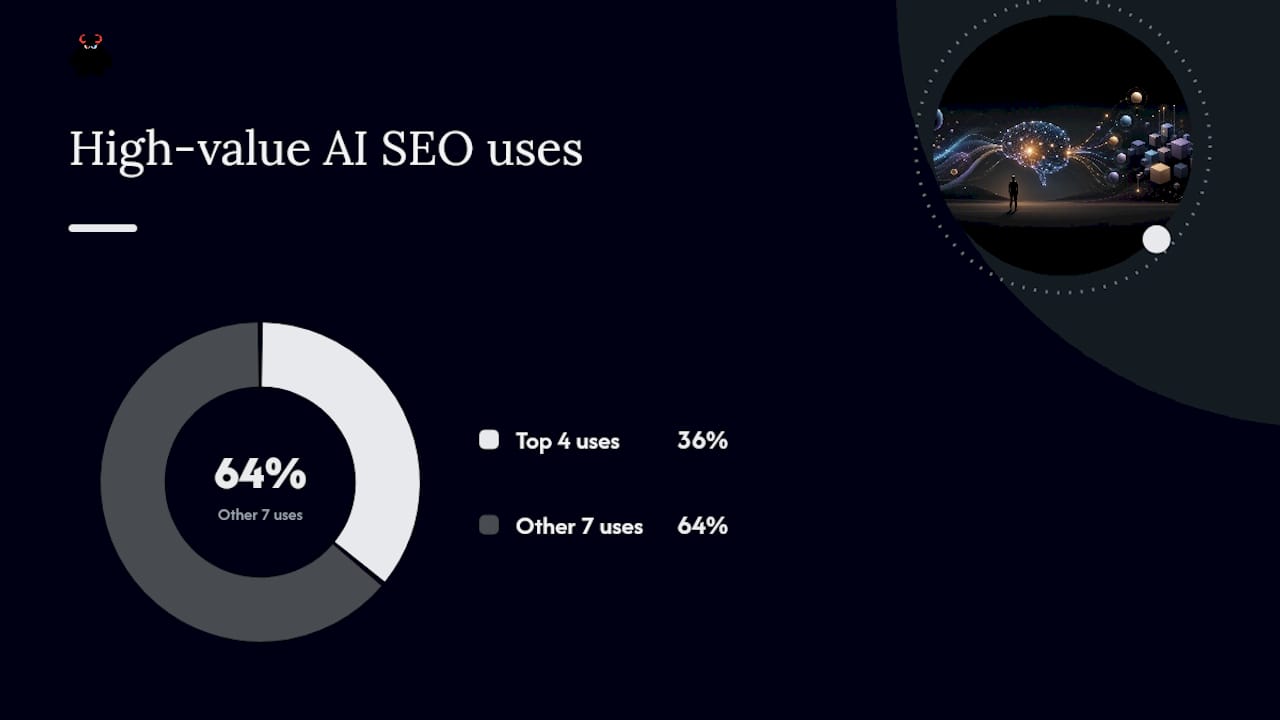
AI-assisted content creation works when it accelerates research and drafting while humans supply the judgment, verification, and original insight that models cannot generate. Semrush’s analysis of 11 AI SEO use cases identifies keyword research, content ideation, SERP gap analysis, and on-page improvement as the highest-value applications, with a consistent guardrail: validate every AI output before publication.
The answer-first writing pattern structures every page for AI extraction. Place a self-contained answer block immediately under each question-style H2. For complex answers, target 120–150 words. For definitional prompts, 40–60 words is sufficient. The block must be liftable verbatim without losing meaning.
Three prompt templates your team can adapt today:
- Idea generation: “List 10 questions a [job title] asks before buying [product/service]. For each, note whether the answer requires proprietary data, third-party evidence, or a how-to format.”
- Outline: “Create a content outline for ‘[target query]’ structured as: one answer capsule (120 words max), three supporting H3s with evidence requirements, one FAQ block (5 questions), and a schema recommendation.”
- Draft-to-final: “Review this draft section for factual claims that require source citations. Flag any claim that could be challenged and suggest the type of evidence needed to corroborate it.”
Editorial guardrails - non-negotiable:
- Every factual claim must be verified against a primary source before publication
- Author credentials and E-E-A-T signals (byline, bio, credentials page) must be present on every piece
- Original research or proprietary data must appear on every pillar page
- A human editor reviews AI-generated drafts for hallucination, tone, and brand accuracy
Ops workflow roles and handoff cadence:
- Researcher: query intent analysis, source identification, original data pull (Day 1–2)
- Author: AI-assisted draft with answer capsules and stat integration (Day 2–3)
- Data validator: fact-check all claims, verify schema markup (Day 3–4)
- Publisher: final review, internal linking, submission to Search Console (Day 4–5)
When deciding between variant pages and a single canonical page, default to canonical. Thin variant pages dilute topical authority and increase the risk of triggering scaled content quality filters. Build one authoritative page per query cluster, then link supporting cluster pages to it.
Pro Tip: Use AI to generate a “challenge list” for every draft: a set of questions a skeptical editor would ask about each factual claim. Answering that list before publication is the fastest way to catch hallucinations and strengthen E-E-A-T signals simultaneously.
Which technical SEO fixes most directly affect generative-AI extraction?
Technical access is the prerequisite for everything else. A page with perfect content and schema earns zero AI citations if crawlers cannot reach it. Google’s developer documentation explicitly discourages shortcuts like llms.txt workarounds and scaled content abuse, redirecting focus to content quality and technical access.
Crawlability checklist:
- Confirm GPTBot, Google-Extended, ClaudeBot, and PerplexityBot are not blocked in robots.txt
- Serve all indexable content in raw HTML or via server-side rendering (SSR)
- Remove login walls, interstitials, and session-based access gates from pages you want cited
- Set crawl timeout thresholds to avoid bot abandonment on slow pages
Rendering and JavaScript guidance: Static site generation (SSG) and SSR are the most reliable options for AI crawler compatibility. Client-side rendering (CSR) alone risks incomplete extraction because many AI crawlers do not execute JavaScript. If your stack is CSR-heavy, implement prerendering for priority pages as an interim fix.
Schema priorities:
Articlewithauthorentity linked to a named person’s credentials pageFAQPageon any page with a question-and-answer structureHowToon process pagesOrganizationandWebSiteat the domain level
Schema supports provenance, meaning it helps AI systems attribute content to a specific, credible source. It does not override content quality, but it does reduce extraction ambiguity.
Multimodal content: Google has confirmed that generative AI features in Search can surface images and video alongside text answers. Every image on a priority page needs descriptive alt text, a relevant filename, and structured data where applicable. For video, provide a transcript and VideoObject schema. Detailed guidance on image SEO best practices covers the full optimization checklist.
Dev team testing checklist:
- Verify bot access with a user-agent spoofing tool (confirm 200 status for each AI crawler)
- Run a render snapshot comparison (raw HTML vs. rendered DOM) to identify content hidden from crawlers
- Audit sitemap coverage: every priority page must appear in the XML sitemap with a correct lastmod date
- Test page load time under bot conditions (no browser cache, no CDN warmup)
- Validate all schema with Google’s Rich Results Test and Schema.org validator
How do you measure AI-driven SEO outcomes and run repeatable experiments?
Rank alone no longer tells the full story. SEOScaleUp’s 2026 strategy playbook establishes that brands must optimize for five parallel surfaces and measure AI mention and citation rates separately from traditional position tracking.
The right metrics:
- Mention rate: how often your brand or page appears in AI-generated answers for target queries
- Citation rate: how often your page is linked or attributed as a source in AI answers
- Mention position: whether your brand appears first, second, or later in multi-source AI responses
- Share of voice across AI engines: your citation rate vs. competitors across ChatGPT, Perplexity, Gemini, and Google AI Overviews
- AI-referral traffic: sessions from AI platforms tracked as a separate GA4 channel group
- Conversion lift from AI referrals: form fills, demo requests, or purchases from AI-referred sessions vs. organic baseline
Experiment template:
- Select 5 control pages (no changes) and 5 treatment pages (add answer capsule + original stat + FAQPage schema)
- Record baseline impressions, AI mention rate, and organic traffic for all 10 pages
- Implement treatment changes and submit treatment pages for re-crawl
- Measure over a 30-day window; require at least 20 prompt tests per query before drawing conclusions
- Compare citation delta and traffic delta between control and treatment groups
Measurement tracking template:
| Page | Baseline Impressions | Baseline AI Mentions | Post-Change Mentions | Citation Delta | Traffic Delta | Conversions |
|---|---|---|---|---|---|---|
| /pillar-page-1 | ||||||
| /pillar-page-2 |
Tagging AI referrals in GA4: Create a custom channel group that captures traffic from perplexity.ai, chatgpt.com, gemini.google.com, and claude.ai as a single “AI Referral” channel. This separates AI-driven sessions from direct and organic, giving you a clean attribution line for conversion reporting.
A typical experiment cycle runs 30 days for initial signal and 60–90 days for statistically reliable conclusions. If citation rate increases but traffic does not, the page is being cited without a click-through link, which is a separate optimization problem (add a more compelling title tag and meta description to increase click probability from AI answer surfaces).
How should you select tools and design AI+human workflows?
Tool selection for AI SEO should be driven by capability categories, not brand names. The categories that matter are: AI writing for draft generation, SERP and prompt analysis, crawler and coverage auditing, schema and markup validation, and analytics with prompt-testing capability. Salesforce’s AI for SEO guide frames the governing principle clearly: AI for speed, humans for judgment.
Selection criteria checklist:
- Data source transparency: does the tool disclose where its SERP or AI data comes from?
- API access: can you pull data into your own dashboards and reporting systems?
- Crawl fidelity: does the crawler accurately simulate AI bot behavior, not just Googlebot?
- Collaboration features: can multiple team members review, annotate, and approve outputs?
- Security and privacy: does the tool support private AI deployments for sensitive client data?
Workflow example pairing:
- AI drafting tool generates outline and answer capsule draft → human author adds original stat and verifies claims → data validator runs fact-check and schema review → publisher adds internal links and submits for indexing → monitoring stack runs weekly prompt tests and flags citation changes
Cost and resourcing considerations: In-house teams typically carry recurring platform fees across three to five tools, plus the internal labor cost of managing them. Managed agency engagements consolidate tooling, oversight, and optimization into a single retainer, which often reduces total cost when you account for the time a senior SEO spends on tool management vs. strategy.
Procurement guidance: Run a 30-day pilot before committing to any platform. Evaluate on outcome metrics: citation lift, time saved per content piece, and quality score on a defined rubric. A tool that saves four hours per piece but produces content requiring two hours of remediation is a net negative. For keyword discovery methodology that applies across both traditional and AI-surface optimization, this analysis of keyword research approaches offers a useful framework for evaluating intent signals.
What does a realistic 90-day AI SEO rollout look like?
A phased rollout prevents the common failure mode: teams that try to implement everything at once and measure nothing. The 90-day structure below separates quick wins from foundation work from scale activities.
Phased roadmap:
- Weeks 0–2 (Triage): Crawlability audit, robots.txt fixes, GA4 AI channel group setup, baseline prompt test suite across 20 target queries
- Weeks 2–8 (Foundation): Answer capsules on top 10 pillar pages, FAQPage and Article schema deployment, one original stat per pillar, SSR/SSG implementation for CSR-heavy pages
- Months 2–3 (Scale): Topical cluster build-out, third-party corroboration outreach, monthly prompt test cadence, experiment analysis and iteration
Resourcing by phase:
| Phase | Role | Estimated Hours |
|---|---|---|
| Triage (Wks 0–2) | Technical SEO lead | 20–30 hrs |
| Triage (Wks 0–2) | Developer (robots.txt, GA4) | 8 hrs |
| Foundation (Wks 2–8) | Content strategist + author | 40–60 hrs |
| Foundation (Wks 2–8) | Developer (SSR, schema) | 20–30 hrs |
| Scale (Mos 2–3) | SEO lead + content team | 60 hrs |
| Scale (Mos 2–3) | Data analyst (prompt testing) | 15–20 hrs |
Cost bands (agency-managed vs. in-house):
- Low (in-house, existing tools): $5,000–$15,000 in labor over 90 days
- Medium (agency-assisted foundation + in-house scale): $15,000–$35,000
- High (fully managed, original research included): $35,000–$75,000+
Managed engagements with a partner like Monstrousmediagroup compress time-to-outcome by eliminating the tool-selection, training, and process-design phases that consume the first four to six weeks of most in-house rollouts.
Ongoing maintenance: AI citation signals decay when competitors publish fresher or more specific content.
How Monstrousmediagroup builds AI SEO systems that protect revenue
Monstrousmediagroup approaches AI SEO as infrastructure, not a campaign. The methodology follows the same four-stage model described throughout this article, but operationalized as a managed system with defined deliverables, measurement gates, and client-facing reporting.
MMG methodology:
- Audit: Full crawl audit plus a prompt baseline across 20–50 target queries; identifies citation gaps, technical blockers, and content structure deficiencies
- Structural changes: SSR/SSG implementation or prerendering for CSR-heavy pages; schema deployment (Article, FAQPage, HowTo, Author entity); robots.txt corrections for AI user agents
- Content program: Answer capsule production for priority pages, original stat integration, topical cluster architecture, and third-party corroboration outreach
- Tracking: Monthly prompt test suite, GA4 AI referral channel group, citation rate dashboard, and conversion attribution from AI-referred sessions
A representative client engagement in the B2B professional services sector illustrates the outcome pattern. The client entered with strong domain authority but near-zero AI citation presence. After the triage and foundation phases (Weeks 0–8), citation rate across Perplexity and Google AI Overviews increased measurably for target queries. AI-referred sessions, tracked as a separate GA4 channel, converted to qualified leads at a rate above the organic baseline. The primary drivers were three technical fixes (GPTBot access, SSR for two key pages, FAQPage schema) and answer capsule additions on the five highest-impression pillar pages.
The pattern holds across verticals: the pages that earn AI citations are not the longest or the most keyword-dense. They are the pages that answer a specific question completely, in a liftable format, with at least one claim no competitor page makes. Original data is the citation hook. Technical access is the prerequisite. Everything else is amplification.
Monstrousmediagroup’s SEO services are built around this outcome model. For teams that need the full infrastructure stack, the AI-powered marketing and development services page covers the integrated offering. The MMG blog also maintains ongoing guidance on adapting SEO strategy to algorithm and AI changes for teams managing this in-house.
Pro Tip: Before any client engagement, MMG runs a “prompt gap audit”: 50 target queries tested across four AI engines, with each result scored for brand presence, competitor presence, and citation source. That baseline is the single most useful document in the first 90 days because it tells you exactly where revenue is leaking to competitors in AI answers.
What a single-SEO team should prioritize this quarter
If your team has one SEO resource and limited bandwidth, the prioritization is clear. Crawlability fixes first, because no other work matters if AI crawlers cannot access your content. Then answer capsules on your 10 highest-traffic pages, each paired with one original statistic. That combination, executed on 10 pages, produces more measurable citation gain than a full site overhaul executed inconsistently.
Pages sitting in positions 8–20 in Google Search Console with solid impression volume are the right targets. They already have topical relevance; they just need the structural and content signals that push them into AI citation range. Starting with zero-impression pages is a longer path to measurable outcomes.
Do/don’t for constrained teams:
- Do corroborate every major claim with a third-party source; AI systems weight independently verified claims higher than brand-only assertions
- Do run a monthly prompt test suite even if it is just 10 queries; the data tells you where to focus next
- Do track AI referral traffic separately from organic; without that separation, you cannot see the revenue impact of citation wins
- Don’t mass-produce thin variant pages targeting slight keyword variations; they dilute topical authority and increase quality filter risk
- Don’t rely on schema alone to earn citations; schema aids extraction but does not substitute for original, specific, well-structured content
- Don’t treat AI SEO as a one-time project; citation signals decay as competitors improve, so the workflow must be recurring
The SEO trends analysis from Reddog Consulting Group reinforces this recurring-system framing: the teams gaining ground in AI search are those that have built repeatable production and measurement workflows, not those that ran a single optimization sprint. For a broader view of integrating AI into your marketing operations, MMG’s blueprint covers the operational architecture in detail.
Monstrousmediagroup builds the AI visibility infrastructure your team needs
Revenue leaks through AI search gaps the same way it leaked through mobile gaps in 2015. The difference is that AI citation losses are harder to see without the right measurement infrastructure in place.

Monstrousmediagroup delivers the full system: technical audit and crawlability fixes, answer-first content programs with original data integration, schema deployment, GA4 AI channel tracking, and monthly prompt test reporting. The MonsterWP managed infrastructure layer handles the SSR, uptime, and performance requirements that gate AI crawler access. For teams that need private AI integrations or custom analytics dashboards, the AI-powered stack covers that too.
The outcome focus is lead recovery and revenue protection, not vanity metrics. If your highest-value pages are not appearing in AI answers for your target queries, that is a recoverable revenue problem with a defined fix sequence. See how Monstrousmediagroup’s SEO systems work and request an audit to establish your prompt baseline.
Sources
- Google’s Guide to Optimizing for Generative AI Features on Google Search | Google Search Central | Documentation | Google for Developers
- SEO Strategy for AI Search 2026: The Complete Playbook | SEOScaleUp